> For the complete documentation index, see [llms.txt](https://docs.flock.io/llms.txt). Markdown versions of documentation pages are available by appending `.md` to page URLs; this page is available as [Markdown](https://docs.flock.io/flock-products/fomo.md).
# FOMO
A guide to FLock Open Model Offering, a launchpad for real model assets that lets anyone turn model usage into a shared, on-chain economy.
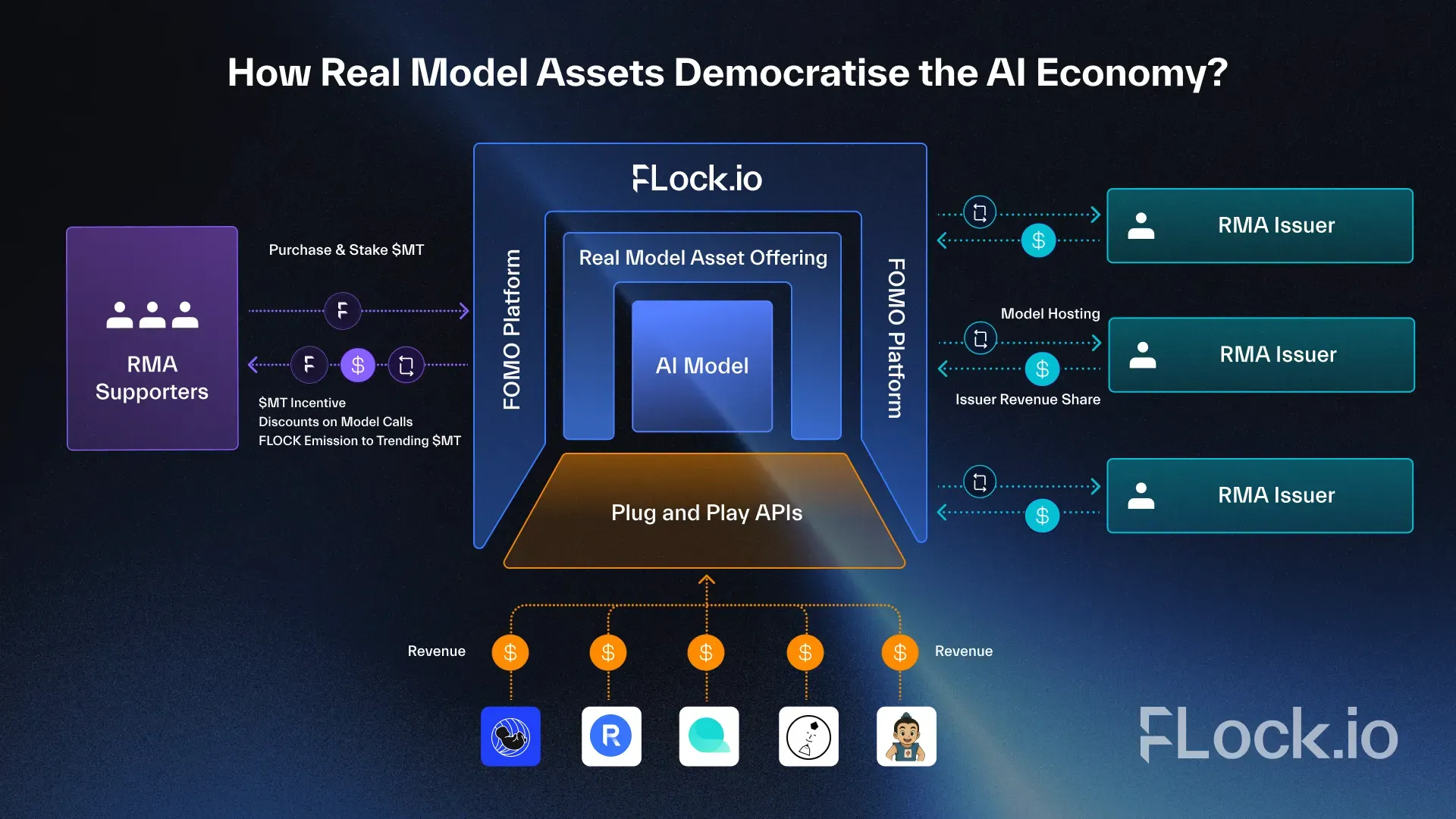
FOMO (FLock Open Model Offering) is a protocol for launching, operating, and monetizing AI model deployments as real, usage-backed economic assets. It connects model deployment, inference usage, and token incentives into a single, deterministic system where value accrues only through real API consumption.
FOMO operates alongside the FLock API Platform, forming a full-cycle AI infrastructure that spans launch, hosting, usage, and long-term incentive alignment.
### System Architecture
FOMO is composed of four tightly coupled layers:
1. **Inference Layer (FLock API Platform)**
Hosts models and serves production inference. All economic activity originates from real API calls paid in fiat or USDC.
2. **Launch Layer (Real Model Asset Offering, RMO)**
Enables RMA (Real Model Asset) Issuers to raise $FLOCK to fund a concrete deployment. Tokens are only minted if the launch meets predefined economic thresholds.
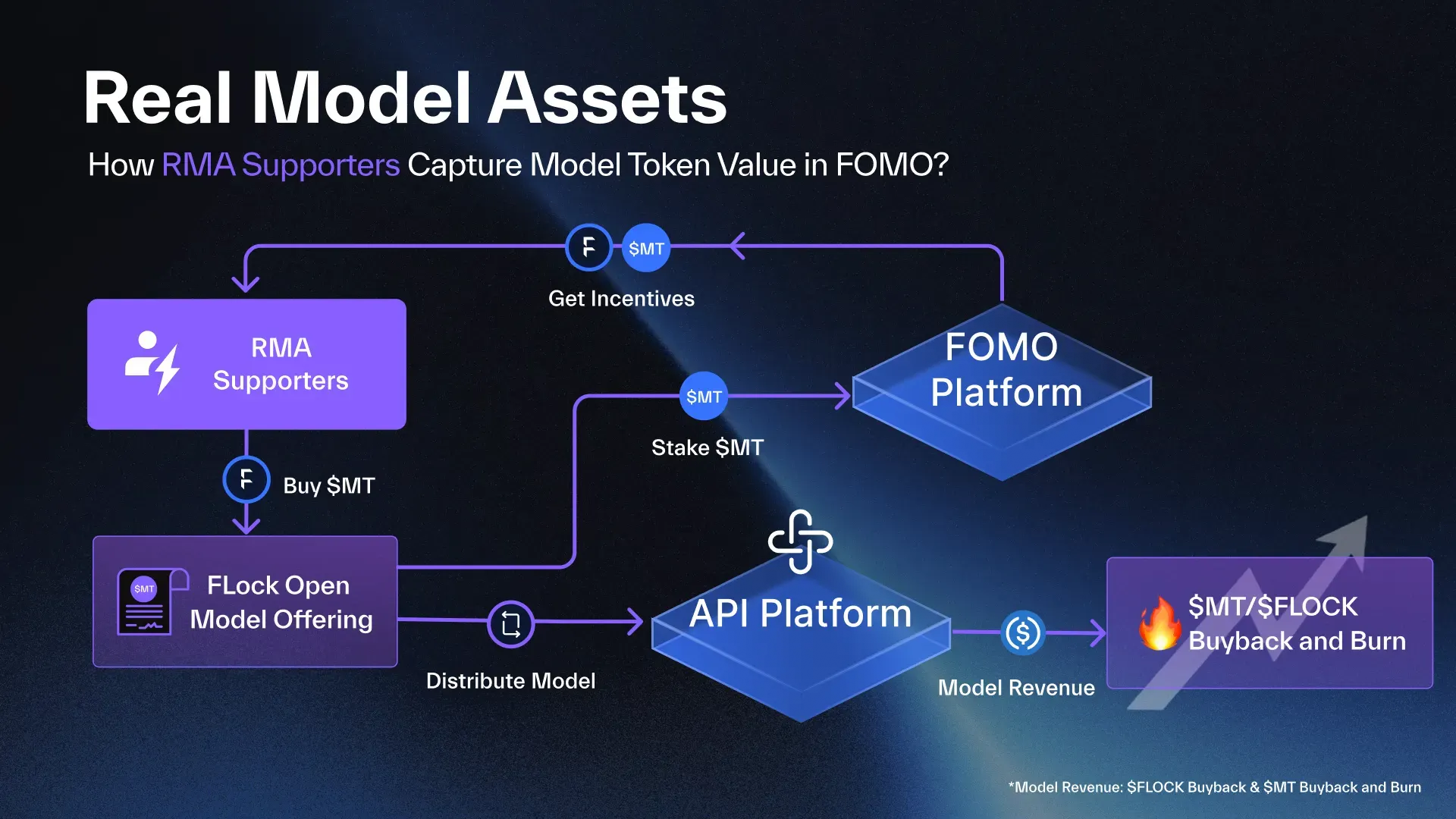
3. **Token Layer ($FLOCK + Model Tokens)**
* $FLOCK coordinates incentives at the network level.
* Model Tokens ($MT) represent individual model deployments with fixed supply and direct exposure to usage-driven buybacks.
4. **Economic Engine (Revenue Routing & Emissions)**
Routes inference revenue into deterministic buybacks, operator yield, and protocol sustainability. Bootstrap emissions are conditional on real usage and decay over time.
5. **Supported Chains (Base & BNB)**\
FOMO currently supports Base and BNB Chain, with Base serving as the default network. Switching networks will disconnect the current wallet session and require the user to re-sign the authentication message before interacting with contracts on the newly selected chain.
---
# Agent Instructions
This documentation is published with GitBook. GitBook is the documentation platform designed so that both humans and AI agents can read, navigate, and reason over technical content effectively. Learn more at gitbook.com.
## Querying This Documentation
If you need additional information that is not directly available in this page, you can query the documentation by asking a question.
Perform an HTTP GET request on the following URL with the `ask` and `goal` query parameters:
```
GET https://docs.flock.io/flock-products/fomo.md?ask=&goal=
```
`ask` is the immediate question: it should be specific, self-contained, and written in natural language.
`goal` is what the user is ultimately trying to achieve, the reason they need the answer. Sharing it helps GitBook give you a better, more relevant answer. A goal is most helpful when it describes the outcome the user wants rather than restating the question. For example, with `ask=how do I create an API token`, a goal like `automate deployments from our CI pipeline` lets GitBook tailor the answer to that use case.
The response will contain a direct answer to the question and relevant excerpts and sources from the documentation.
Use this mechanism when the answer is not explicitly present in the current page, you need clarification or additional context, or you want to retrieve related documentation sections.